
Braids are the easiest festival hair there is. Once they’re in, they can last for days, they keep your hair off your face and out of the dust or mud, and you don’t need any products, heat or even a mirror to keep them looking good.
I’ve always had long hair, and I’ve been going to festivals for well over 15 years. The longest I’ve camped for was over a week at Boom Festival in Portugal, in extreme heat and a hot, dry, dusty climate, and my hair survived. What I’ve learned is that the less you have to do to your hair in a field, the better. Washing long hair at a festival is rarely practical, and braids are a style you can put in before you leave and then forget about.
Which Braids Last the Longest?
The braids that last are the ones that pick up hair as they go, so all of it is held close to your head. A single plait hanging down your back will be fluffy by the end of the first day. These will go a lot longer:
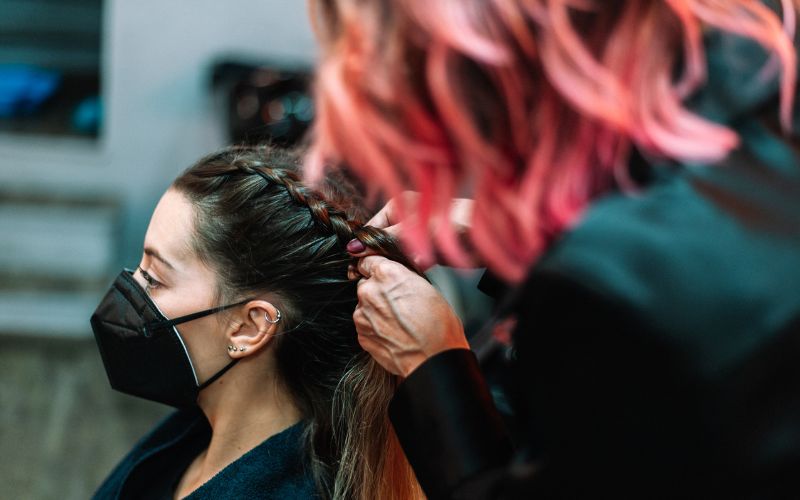
- French and Dutch braids. Both add a little more hair to each strand as you braid down your head. In a French braid you cross the strands over the middle, so it lies flat. In a Dutch braid you cross them under, so the braid sits up on top of your hair. Two of them, one on each side, is the classic festival look, and done well they can last a whole week with no maintenance.
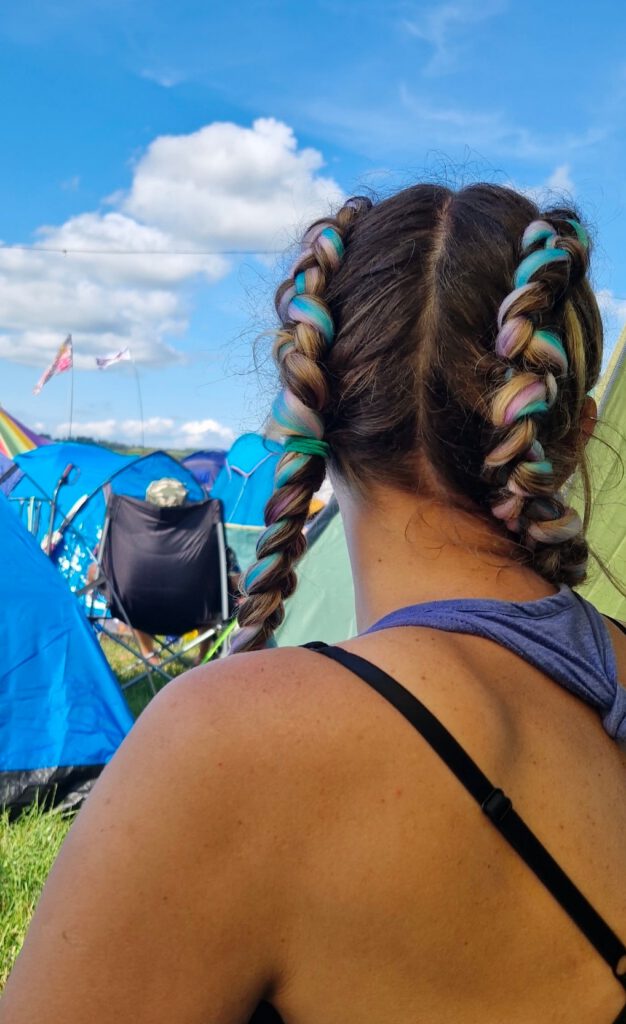
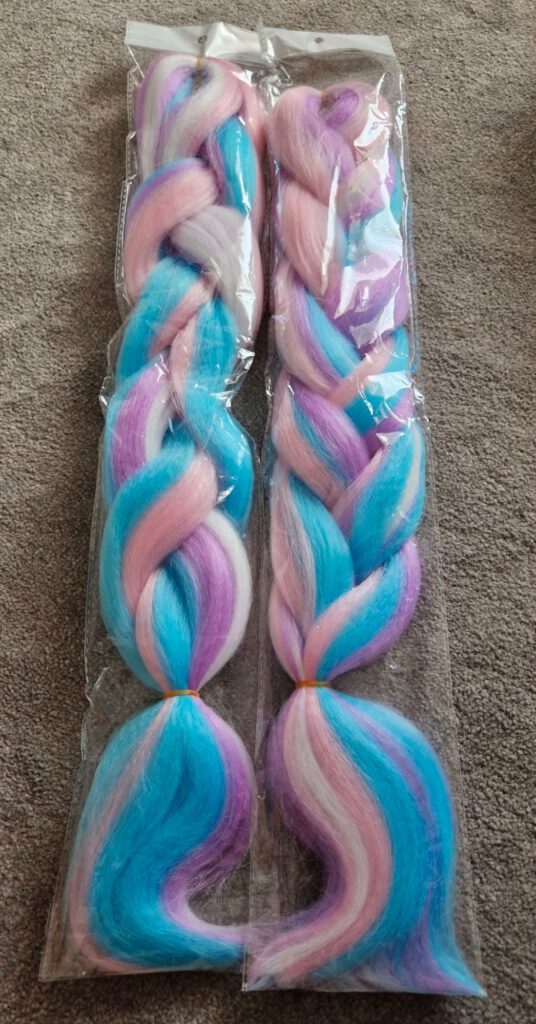
- Feed-in braids. The colourful braids you see all over festivals are usually Dutch braids with synthetic braiding hair fed in as you go, which makes them longer, thicker and brighter. They’re very hard to do neatly on yourself.
- Cornrows. Rows of small braids close to the scalp, using the same underhand technique as a Dutch braid. Because they’re so flat and tight to your head, there’s very little to work loose.
- Box braids. Individual plaits made from small square sections, usually with extensions added. They take hours to put in, but they’re designed to last for weeks, not days.
Cornrows and box braids come from Black hair traditions with a long history, and they’re protective styles for afro-textured hair. If that’s your hair type, go to an experienced braider who knows how to care for it.
How to Make Your Braids Last
- Start with clean, fully dry hair. Wash it as close to leaving as you can, and make sure it’s completely dry before you braid. Braided damp hair stays damp inside the braid for a long time, especially in a tent. Brush out every tangle first, because anything you braid in stays in.
- Braid firmly, but not painfully. Neat, snug braids last longer than loose ones, but if they feel sore or itchy, or give you a headache, they’re too tight. Constant pulling on your hair can cause traction alopecia, which is hair loss from tension, and the British Association of Dermatologists warns that it can become permanent if it carries on. Be especially gentle around your hairline.
- Use a little product on the lengths only. A small amount of leave-in conditioner or a light oil on the lengths before you braid keeps them smooth and stops the ends drying out. Go easy on gel: a little helps with flyaways while you braid, but in dry weather the dust sticks to it.
- Secure the ends with snag-free ties. Small fabric-covered hair ties hold the ends without catching your hair. Thin rubber bands grip well but can snag and snap your hair when you take them out. If you’ve used synthetic braiding hair, braiders usually seal the ends by dipping them in hot water, so take care with a freshly boiled kettle.
- Sleep in a satin cap or bonnet. Rubbing against your pillow and sleeping bag all night is what makes braids go fuzzy. I’ve recommended a satin cap in my festival hair care guide for long hair, along with tips on washing and protecting your hair from the sun.
- Touch up flyaways, then leave them alone. A drop of hair oil or leave-in smoothed over the top with your fingertips tidies any fluff. The more you fiddle with your braids, the faster they loosen. A bit of frizz by the last day is normal.
About the product boxes in this guide: they link to Amazon, and they’re affiliate links. If you buy through one, we earn a small commission at no extra cost to you. Each one was chosen for the reasons given in the box, based on the manufacturer’s specifications, and was in stock when we checked in November 2026.
Best for: Securing the ends of your braids
Heliums Mini Hair Ties, Neutrals Mix (Pack of 48) (opens in a new tab)
These tiny 2mm hair ties are covered in stretchy fabric and have no metal join, so they hold the end of a braid without snagging or breaking your hair. There are 48 in the pack, which means it doesn't matter when a few go missing in the tent.
- Fabric-covered, with no metal join
- 2.5cm across, sized for braids and small ponytails
- Pack of 48 in hair-matching shades
- Too small to hold a full ponytail of thick hair
How to Do a Dutch Braid Yourself
You can braid your own hair, but it takes practice, and you need flexible shoulders and a lot of patience to get it neat on the back of your own head. Have a few goes at home before the festival. These steps are for two Dutch braids. For French braids, do exactly the same but cross the strands over the middle instead of under.
- Brush your hair until there are no tangles left. Part it down the middle from your forehead to the nape of your neck, and tie one side out of the way.
- At the front of your hairline, take a section of hair and split it into three equal strands.
- Cross the right strand under the middle strand, then cross the left strand under the new middle strand.
- Before each cross, pick up a small section of loose hair from that side and add it to the outside strand, then cross it under the middle. Keep the sections roughly the same size so the braid looks even.
- Carry on down your head, keeping the braid close to your scalp and pulling each cross snug but not tight.
- When there’s no loose hair left to pick up at the nape of your neck, carry on with an ordinary three-strand plait, still crossing under, to the ends. Secure it with a hair tie.
- Repeat on the other side, starting at the same height so the two braids match.
For feed-in braids, you add small pieces of synthetic braiding hair to the outside strands as you go, adding a bit more every few crosses so the braid gets gradually thicker and longer. Pre-stretched braiding hair is the easiest to work with, because the ends are already tapered. Doing this neatly on your own head while also picking up your own hair is tricky, so it’s much easier to have someone else do it.
Getting Your Braids Done
- A friend. If you know someone who’s good at braiding, get them to do yours the night before or the morning you leave. If they’re done the night before, sleep in a satin cap.
- A hairdresser or braider before you go. Ask your hairdresser whether they do braids, and show them photos of what you want. Book early, as appointments get busy in festival season.
- At the festival. Some festivals have hair and beauty stalls that will braid your hair for a fee, but not all do, and prices and queues vary. Check the festival’s website or map before you rely on one.
Decorating Your Braids
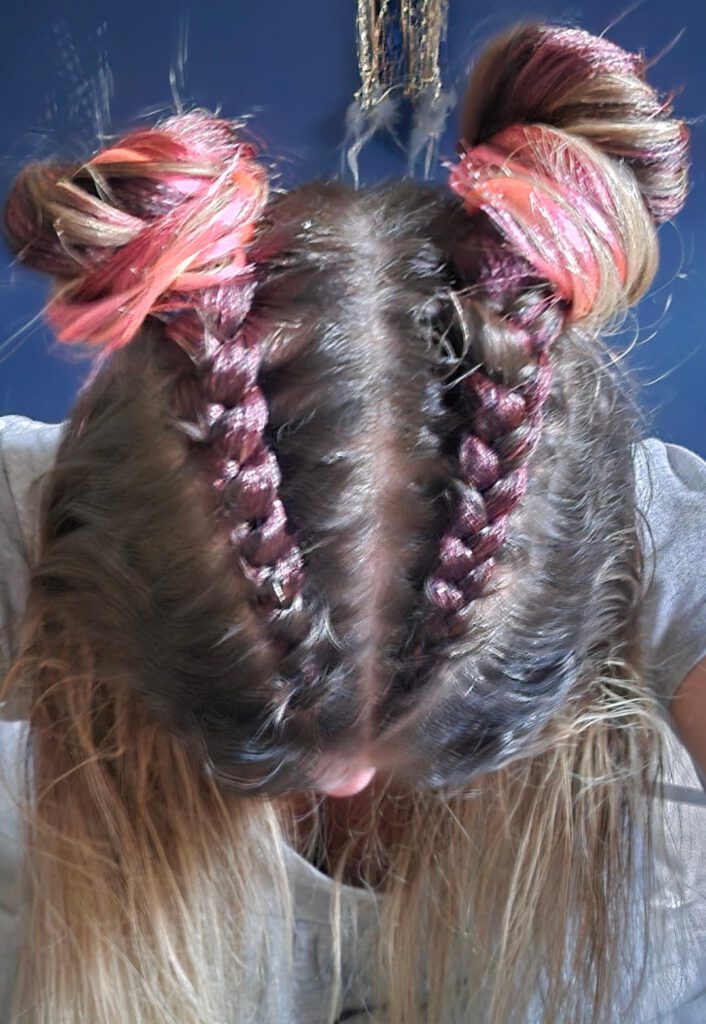
If you want to dress them up, braid cuffs and rings slide or clip onto a finished braid, and you can plait a ribbon into one of the strands as you go. Small flowers tucked into the braids work well for a day. If you’re putting glitter on your parting, choose a biodegradable one rather than plastic glitter. Braiding hair with a bit of sparkle in it is another option, and you can twist the ends of two braids up into space buns for a change.
Taking Your Braids Out
After a few days, your hair will be dusty and quite knotted at the ends, so go slowly:
- Remove the hair ties carefully. If you have to cut one off, cut the tie, not your hair.
- Undo each braid from the ends upwards, gently separating the strands with your fingers. If you’ve got synthetic hair fed in, ease it out as you go rather than pulling it.
- Work some conditioner through, then detangle with your fingers or a wide-tooth comb, starting at the ends and working up.
- Wash as normal. I shampoo twice to get all the festival grime out, then use a deep conditioning mask.
Don’t panic about the amount of hair that comes out. Most of it is hair that would have shed anyway while it was held in the braids: the NHS says we can lose between 50 and 100 hairs a day without noticing.